In environmental monitoring and field intelligence, there is no such thing as a one-size-fits-all network protocol. The physical reality of the deployment site dictates the technology.
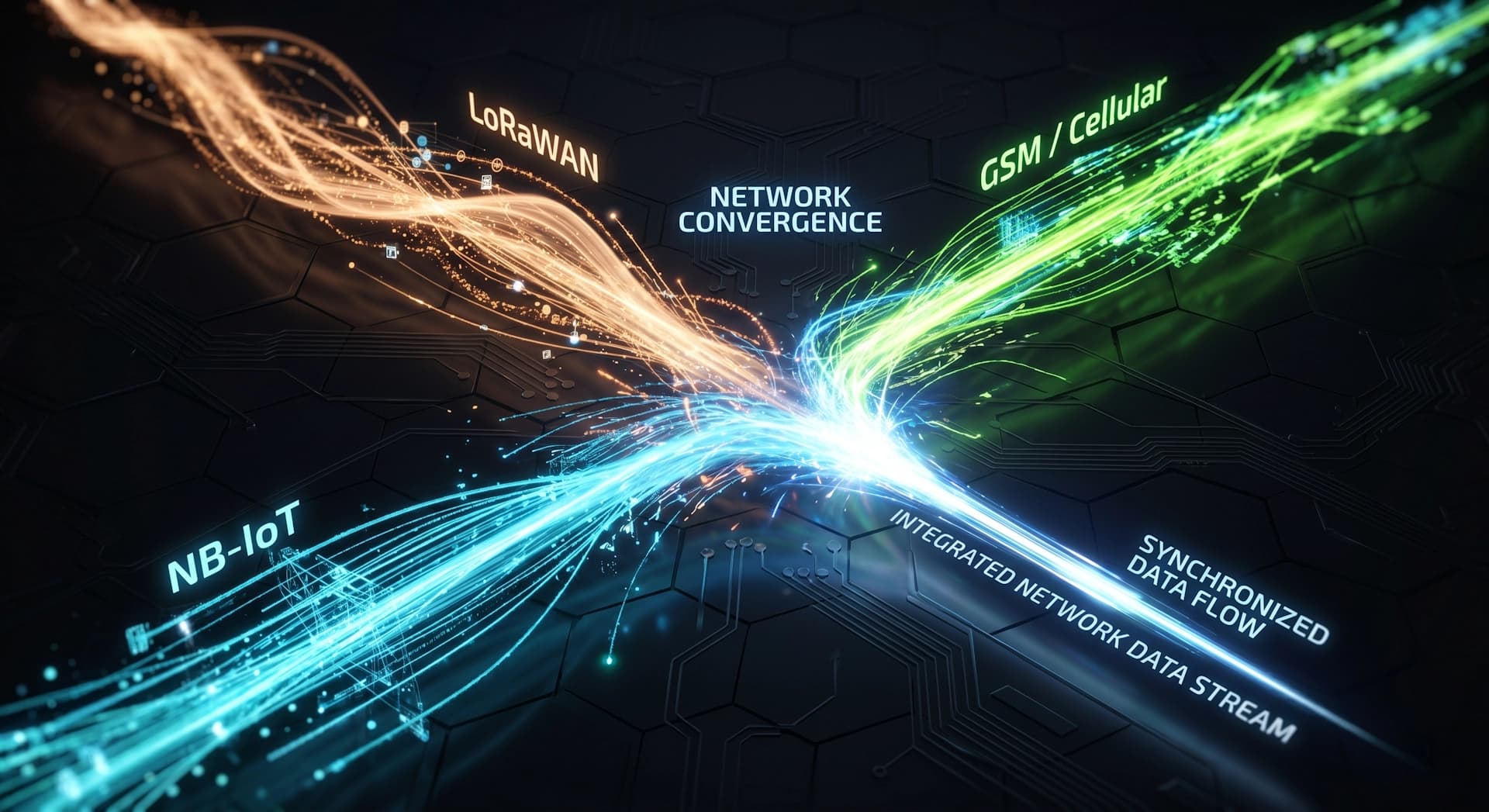
A project spanning an entire municipality will inevitably become a patchwork of communication standards. Deep underground sensors in concrete water pits require the extreme penetration of NB-IoT. Legacy weather stations in rural areas rely on standard GSM cellular networks. Meanwhile, a cluster of soil moisture sensors in a dense forest with zero cellular coverage might depend on a private LoRaWAN gateway.
This diversity is an engineering necessity, but for operations managers and decision-makers, it quickly turns into a logistical nightmare known as the Multi-Network Trap.
The Cost of Transport Fragmentation
Unlike hardware vendor lock-in - where equipment manufacturers force you into their proprietary clouds - network fragmentation is an infrastructural problem. Even if you use open-source hardware, data transmitted via LoRaWAN arrives at a different network server (like The Things Network) than data transmitted via an operator's NB-IoT infrastructure.
When integrators fail to account for this at the software level, the results are highly disruptive for B2B clients:
- Segmented Workflows: Operators must log into one platform to check the LoRaWAN forest nodes, and another to monitor the GSM hydrological buoys. Each login is a context switch that costs time and introduces human error.
- Analytical Blind Spots: Correlating data becomes nearly impossible. If a sudden rainstorm captured via GSM causes a flood downstream captured via LoRaWAN, the system cannot automatically overlay these two events on a single timeline without manual CSV exports and spreadsheet work.
- Alerting Chaos: Incident response is severely delayed when warning thresholds are scattered across multiple isolated network dashboards. Critical warnings are missed not because the sensors failed, but because no single operator can watch three separate screens simultaneously.
The Architectural Fix: Decoupling Data from the Highway
To resolve the Multi-Network Trap, the visualization and analytics layer must be entirely abstracted from the transport layer. The network should be treated simply as a delivery mechanism, not a destination. This mirrors the same principle we apply when breaking data silos caused by hardware vendor fragmentation.
At Silentbits, we architect unified telemetry platforms that act as a central ingestion hub. Instead of forcing the client to adapt to each network's limitations, we deploy a backend structure that speaks every protocol simultaneously:
- Webhooks for LoRaWAN: Instantly catching lightweight payloads from private gateways as they arrive in real time, eliminating polling delays.
- REST APIs for NB-IoT: Periodically pulling synchronized data from telecom clouds using a watermark-based strategy that guarantees zero data loss, even after connectivity outages.
- Secure FTP for GSM: Parsing legacy CSV logs dropped by remote stations operating in store-and-forward mode, handling irregular upload schedules and backfilling historical gaps automatically.
All these disparate data streams are normalized, timestamped, and fed into a single time-series database. The ingestion engine becomes the Rosetta Stone of your field infrastructure.
One Dashboard, Absolute Control
By consolidating the network streams at the backend, the end-user experience is completely transformed. In the frontend interface, the complexity of radio waves and SIM cards disappears entirely.
When a hydrologist or a city official opens the custom dashboard, they see all their infrastructure on a single, interactive map. A water-level radar using LoRaWAN sits right next to a GSM rain gauge. The data can be correlated on unified dual-axis charts, and a centralized alerting engine can trigger SMS warnings based on the combined logic of the entire grid.
We implemented this exact architecture in the Wodowskaz platform, where sensors from three incompatible hardware ecosystems - each using different transport protocols - were unified into a single high-performance web interface. Operators went from managing three separate logins to monitoring everything from one screen.
Public Access Without Operational Overhead
A unified backend also unlocks advanced distribution capabilities that fragmented architectures simply cannot support. When all network data flows into one platform, serving it publicly becomes a controlled, scalable operation.
Municipal clients increasingly require public-facing dashboards - citizens checking local river levels, researchers downloading historical datasets. With a single data layer, you can implement edge-cached public widgets and asynchronous export endpoints without touching the core ingestion engine. The pattern is described in detail in our public telemetry article, where we explore how to serve a city of a million people from the same infrastructure that serves a single field engineer.
The Business Value for Integrators
For systems integrators, network unification is a decisive competitive advantage in public tenders. When a municipality or environmental agency evaluates bids, the ability to offer one unified platform across all connectivity types is a rare differentiator - most competitors propose three separate dashboards patched together with manual export workflows.
Outdoor IoT deployments will always require diverse connectivity solutions to survive harsh environments. But the complexity of the field should never dictate the usability of the software. By aggregating multiple network protocols into one custom integration platform, organizations regain full visibility and control over their environmental data - regardless of what radio wave delivered it.
The Multi-Network Trap is an infrastructural problem that demands a software-level solution. By treating LoRaWAN, NB-IoT, and GSM as interchangeable transport layers feeding a single ingestion hub, integrators can deliver the unified operational experience that modern public and industrial clients require. If your current monitoring stack forces operators to juggle multiple network dashboards, it is time to rethink the architecture. Explore how we handled multi-vendor hardware fragmentation in our vendor lock-in article, or see how our telemetry dashboards are designed to consolidate every data source into one coherent interface.