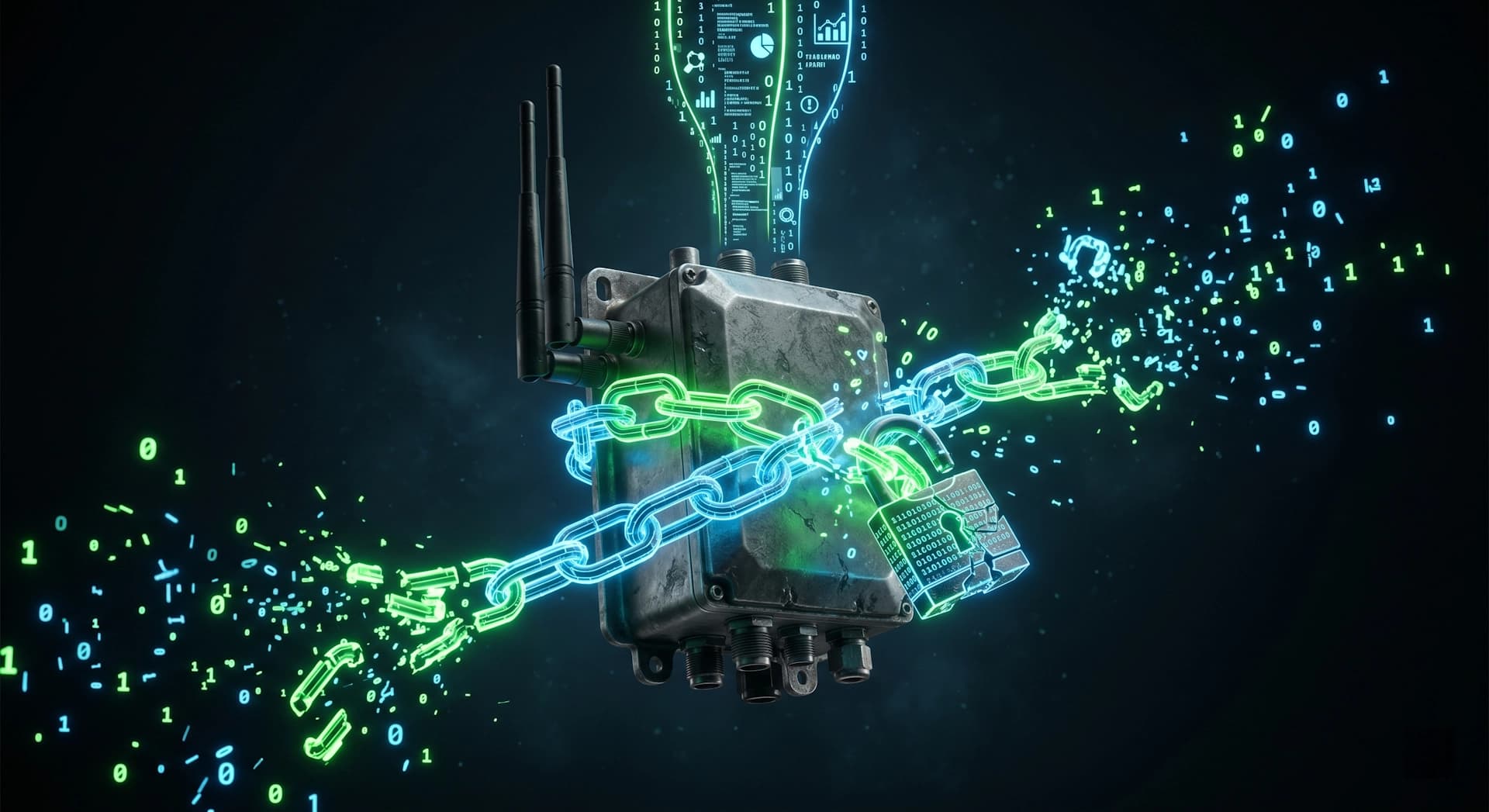
A live dashboard is not the end of the story for most monitoring operators. At some point, someone has to answer to a regulator, a board, or a client who wants a PDF in their inbox - not a login link. That someone is usually an engineer with better things to do.
Across environmental and field intelligence deployments, the pattern repeats: an operations manager logs into the platform once a month, filters a date range per station, exports a handful of CSVs, pastes the numbers into a branded template, and emails it out before a deadline. It works, until the network grows past a handful of stations or the recipient list grows past a handful of people.
This is not a data problem. The sensors are already capturing everything correctly. It is a delivery problem - and it is one of the easiest operational costs to eliminate once you stop treating reporting as a manual export and start treating it as a scheduled service.
The Manual Reporting Tax
Recurring reporting is a fixed operational cost that most organizations never put a number on. Multiply the export-format-email routine by the number of stations, the number of recipients, and the reporting frequency a compliance framework demands, and the hours add up fast - every single month, indefinitely.
It also fails in three predictable ways once a network scales past a single engineer's attention span:
- It is bus-factor-one. The report goes out on time because one specific person remembers to run it. When that person is on leave, the deadline slips.
- It doesn't scale with the client list. A white-label integrator serving twenty municipalities cannot manually assemble twenty monthly PDFs without hiring for it.
- It is error-prone by construction. Manual CSV exports and copy-paste formatting are exactly the kind of repetitive task where a wrong date range or a missed station goes unnoticed until someone downstream complains.
From On-Demand Export to a Scheduled Service
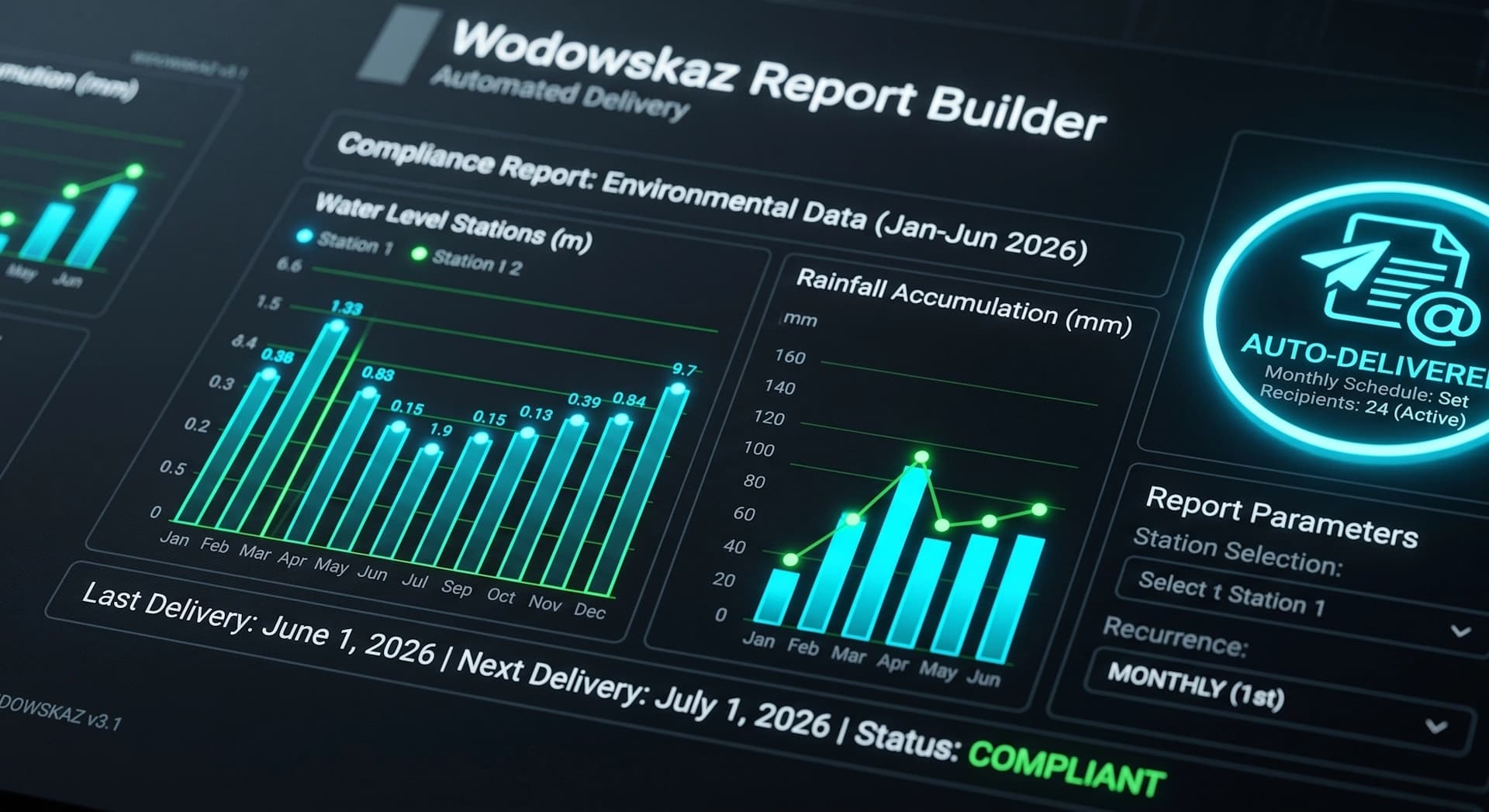
The fix is architectural, not procedural: reporting has to become a first-class, configurable object in the platform - not an afterthought bolted onto the export button. We built exactly this as the Wodowskaz Report Builder: a report-configuration engine where a user defines the stations, parameters, and time range once, sets a recurrence (daily, weekly, or a custom interval), and points it at a recipient list or a download endpoint.
From that point on, the system does the work every cycle: it pulls the current data window, renders it into a branded PDF - carrying the client’s own logo, not ours or the sensor manufacturer’s - and either emails it out or leaves it ready for download. The operator’s job shrinks from "produce a report" to "define a report once."
Ad hoc requests do not disappear, and they should not be forced through the same pipeline. A researcher asking for a one-off custom date range still needs an on-demand path. So the same engine that runs recurring jobs on a schedule also serves manual, parameter-scoped generation for exactly that case - one system, two delivery modes, no separate tooling to maintain.
Turning a Cost Center into a Deliverable
For systems integrators, automated reporting is not just an internal efficiency gain - it changes what you can sell. A recurring, branded PDF delivered automatically to a municipality’s inbox is a concrete, demonstrable feature in a tender response, in a way that "you can also export a CSV" never is.
It also fits directly alongside the wider shift toward public and institutional data access we covered in our piece on public telemetry: dashboards and IFrames serve the people who want to look at data right now, while scheduled reports serve the people whose job is to file it, archive it, or forward it up a chain of command. Both are the same underlying data, shaped for a different consumer.
The result is the same principle we keep coming back to: own the software layer, and reporting stops being a recurring line item on someone's calendar and becomes a feature you can point to when you're bidding for the next contract.
A monitoring platform that cannot deliver its own compliance reports is quietly asking your team to do that work by hand, forever. Automating the delivery - not just the collection - of environmental data is what turns a technically sound sensor network into an operationally sound one. See the feature in context in the Wodowskaz case study, or explore how our telemetry dashboards are built to serve both live viewers and scheduled recipients from the same data layer.